Why are the Artemis Accords important?
The Artemis Accords are of importance for Australia as they were one of the original seven signatories alongside the United States in 2020. The Australian Space Agency highlights that Australia’s support of the Accords aligns with their aim to support “the development of rules, norms and principles for the safe, stable and sustainable use and exploration of outer space.” The aim of the Artemis Accords to facilitate a sustainable human presence in, and use of, Outer Space aligns with the missions of Plants for Space. Furthermore, the LEAF experiment involving the investigation of plant growth on the Moon, of which Plants for Space is a partner, is due to be conducted during the Artemis III mission. This experiment will be subject to the guidelines of the Artemis Accords, as will any future experiments undertaken in conjunction with the Artemis project and future lunar experimentation for which the guidance of the Artemis Accords will have set the precedent.
What are the Artemis Accords?
The Artemis Accords are described as ‘Principles for Cooperation in the Civil Exploration and Use of the Moon, Mars, Comets, and Asteroids for Peaceful Purposes’. These principles or guidelines are outlined in thirteen sections and address various points including maintaining ‘peaceful purposes’, as was established in the 1967 Outer Space Treaty, as well as establishing the sharing of scientific data obtained from activities that fall under the Accords, and regulating the use of space resources to support and sustain Space activities and providing for the establishment of safety zones around activities being undertaken on the lunar surface to prevent harmful interference between acting parties.
How did the Artemis Accords come about?
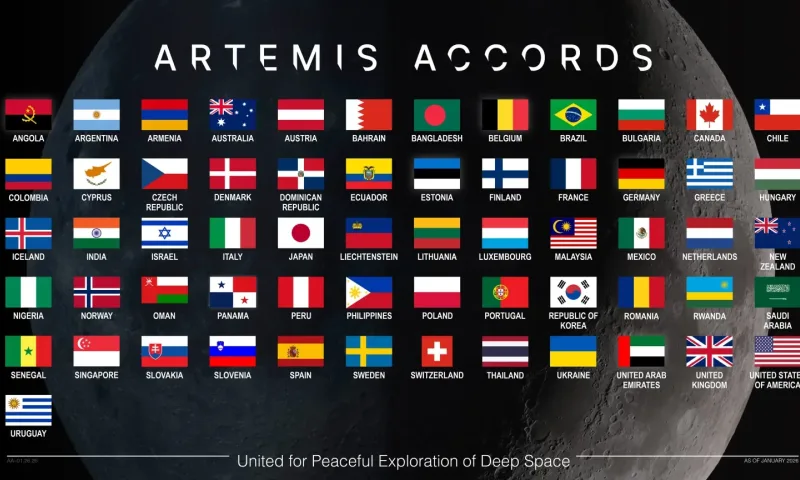
Following on from the 2017 announcement of President Trump of the United States’ intention for the return of humans to the Moon, which has now developed into the Artemis missions, the Artemis Accords were formed in 2020. Seven original signatory States, with the United States, have now expanded to sixty-one signatory States, alongside commercial partners to the Artemis missions.
What purpose do the Artemis Accords serve?
With the Artemis missions progressing and the Artemis II launch scheduled for March 2026, the Artemis Accords stand to serve a central role in the future of human activity in Outer Space. What role is this exactly? The Accords provide guidance on how activities to be carried out on the lunar surface by the parties involved should be conducted. These guidelines aim to, as outlined in Section 1 of the Accords themselves, “enhance the governance of the civil exploration and use of outer space with the intention of advancing the Artemis Program”. This governance is achieved through the agreement of the sixty-one signatory States to comply with the guidelines and practices outlined in the Accords by way of political agreements with State’s space agencies. This means that the Accords do not constitute binding international law. However, the existing instruments that comprise the international space law framework, such as the foundational 1967 Outer Space Treaty are acknowledged in the preamble and built upon throughout the Accords, with the exception of the 1979 Moon Agreement, to which the United States is not a signatory.
Dr Ciara Finnegan is an ARC CoE in Plants for Space funded post-doctoral researcher in space law. She researches the law and ethics surrounding space-bound plant experiments being carried out on Earth. She also investigates the development and evolution of regulations around plants in space. She received her PhD entitled ‘How the Principle of Humanity in International Humanitarian Law can inform Weapons Regulation in Outer Space’ from Maynooth University, Ireland.
Click here to visit the NASA Artemis Accords website.